Revinate Scales Global Hospitality Platform and Guest Data Access Using Amazon API Gateway


The rapid acceleration of application programming interface adoption coupled with the concurrent reduction of operational overhead remains a formidable technical challenge for high-growth global enterprises. For Revinate, a prominent hospitality technology provider serving more than 12,500 hotels worldwide and managing an immense repository exceeding 1.25 billion unique guest profiles, these architectural demands reached a critical inflection point. To support its expanding artificial intelligence-powered Customer Data Platform—which has successfully driven over $24 billion in lifetime direct revenue for hoteliers while diminishing reliance on third-party online travel agencies—the company required a robust, highly scalable, and secure API infrastructure. The solution was found in the strategic deployment of Amazon API Gateway combined with the newly introduced Amazon API Gateway Portal.
Background Context and Evolving Business Demands
Revinate empowers hoteliers to establish direct connections with guests across every operational touchpoint, utilizing data-driven insights to maximize revenue and guest retention. As the organization expanded the analytical and programmatic capabilities of its Customer Data Platform, the imperative to expose rich guest data through secure APIs became undeniable. Partner hotels, third-party developers, and integrated technology vendors required reliable, programmatic access to reservation histories, granular guest profiles, and critical hospitality metrics.
Initially, managing API infrastructure through self-hosted or internally provisioned mechanisms presented significant operational bottlenecks. Each new integration demanded manual administrative provisioning, bespoke security configurations, and continuous maintenance oversight. This manual overhead diverted valuable engineering hours away from core product innovation. Recognizing that a self-managed or proprietary architecture would introduce unsustainable long-term maintenance costs and hinder time-to-market objectives, Revinate executive and engineering leadership initiated a comprehensive evaluation of enterprise integration strategies.
The evaluation process established four foundational business drivers: aligning infrastructure costs directly with actual API consumption through on-demand pricing models, implementing authentication federation to integrate seamlessly with existing identity providers, deploying automated rate limiting to protect backend microservices against abuse, and maintaining rigorous security standards to safeguard sensitive consumer data under strict international compliance mandates.
Evaluating Alternative API Management Strategies
The engineering team systematically assessed three distinct architectural pathways, weighing each against criteria encompassing financial scalability, operational burden, and technical flexibility.
The first alternative, a self-managed API management approach utilizing open-source gateways, offered initial architectural flexibility and avoided direct software licensing fees. However, it imposed substantial ongoing operational responsibilities, including continuous infrastructure management, manual security patching, horizontal scaling orchestration, and the development of a proprietary developer portal from scratch.
The second alternative involved building a custom proprietary API gateway tailored entirely to Revinate’s unique specifications. While this path promised maximum localized control, it necessitated an exorbitant upfront capital investment in software development and perennial maintenance. Building essential routing, authentication, throttling, and documentation modules in-house would have severely diverted engineering resources from enhancing core hospitality platform features.
The third alternative focused on traditional enterprise API management platforms. Although these commercial solutions provided comprehensive out-of-the-box feature sets, they introduced undesirable vendor dependencies, inflated capital expenditures, and rigid fixed-term licensing models. These financial structures fundamentally misaligned with Revinate’s revenue growth patterns, demanding fixed outlays regardless of actual platform adoption rates.
Ultimately, leadership concluded that all three traditional approaches shared a fatal flaw: they diverted critical engineering talent and financial resources toward undifferentiated heavy lifting rather than focusing on features that deliver direct value to hotel operators.
Implementation of Amazon API Gateway and Managed Developer Portal
To circumvent these operational roadblocks, Revinate selected Amazon API Gateway paired with the Amazon API Gateway Portal. This AWS-native combination provided the comprehensive functionality of a premier enterprise API management platform while eliminating fixed-term licensing constraints and unnecessary operational overhead.
The architectural foundation relies heavily on fully managed infrastructure, allowing Revinate’s engineering personnel to redirect their focus toward expanding core Customer Data Platform capabilities. Furthermore, native integration with other Amazon Web Services—including Amazon Elastic Kubernetes Service for containerized microservices and AWS Lambda authorizers for federated authentication—enabled the company to authenticate external API consumers efficiently against its existing identity provider infrastructure with minimal custom code.
To uphold strict corporate governance and ensure operational repeatability, the engineering team adopted a rigorous infrastructure-as-code methodology utilizing Terraform exclusively for all production deployments. By leveraging the AWS provider for Terraform, developers defined complete API Gateway configurations—spanning REST APIs, deployment stages, usage plans, and security authorizers—as version-controlled code artifacts. This declarative approach guarantees cross-environment consistency, facilitates thorough peer reviews of infrastructure modifications, and generates complete, unalterable audit trails required for regulatory compliance.
Financial optimization was achieved through Amazon API Gateway’s pay-per-use pricing model. During the platform’s initial rollout phase, operational expenditures remained negligible, scaling naturally in direct correlation with incoming customer onboarding volume. Implementation of structured usage plans and API keys enabled precise per-consumer cost attribution, affording financial leadership clear visibility into infrastructure utilization metrics across individual hotel properties and enterprise partners. This consumption-based model successfully replaced burdensome annual licensing commitments.
Additionally, the adoption of the Amazon API Gateway Portal served as an integrated, AWS-native central hub for API discovery, interactive documentation, and developer governance. By utilizing this managed portal, the organization bypassed months of custom frontend development, providing external developers with immediate access to interactive “try-it-now” documentation, automated subscription management, and streamlined credential generation.
Advanced Architecture and Target Group Binding
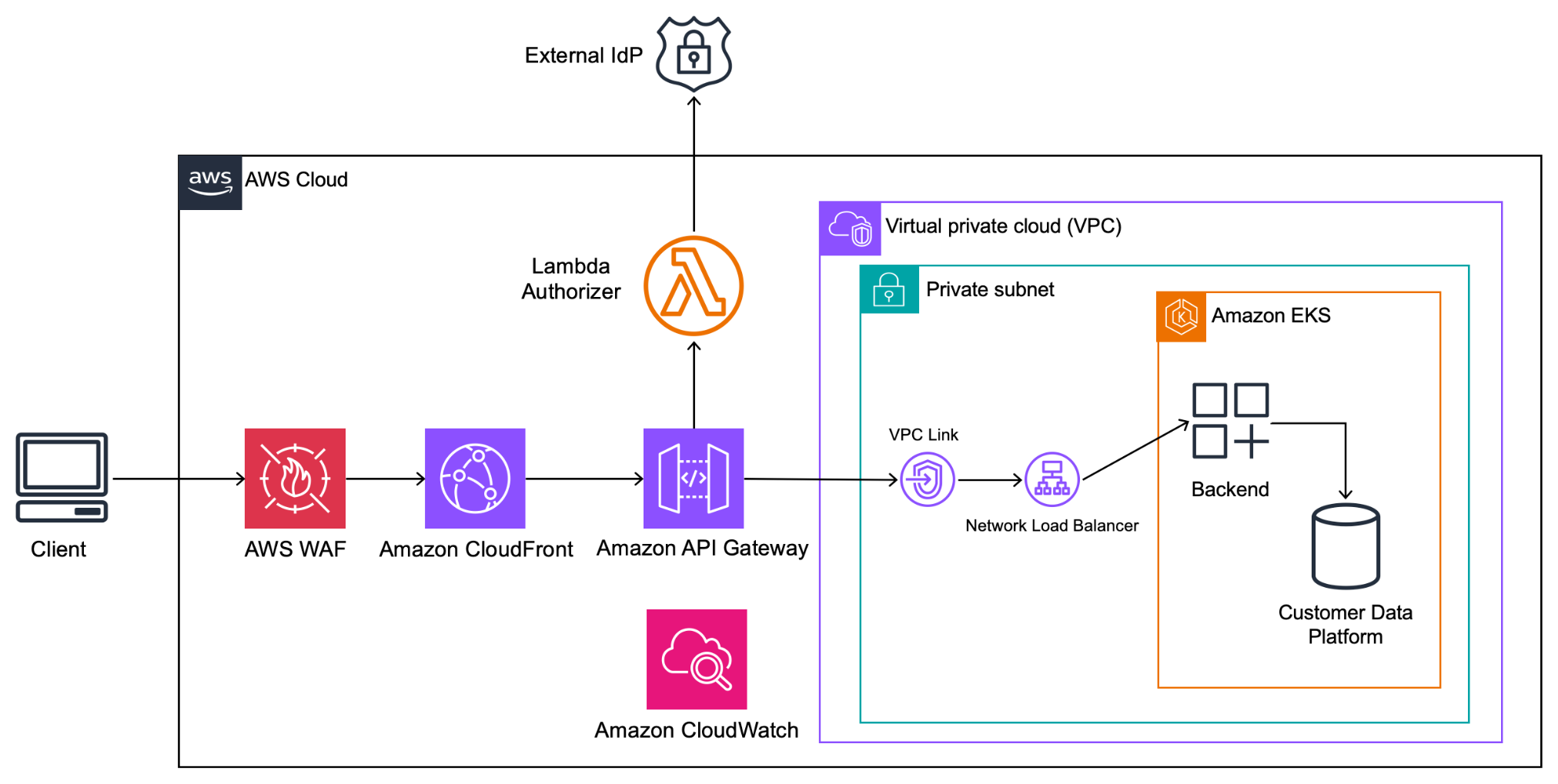
The end-to-end data flow begins when global hotel properties access the platform via Amazon CloudFront to ensure optimal edge caching and minimal latency. AWS WAF provides comprehensive perimeter defense against malicious web traffic and automated bot threats. Incoming requests then traverse Amazon API Gateway, which acts as the unified, secure entry point for all operational traffic.
Lambda authorizers execute token-based validation by communicating directly with the external identity provider via the OAuth 2.0 client credentials flow, guaranteeing secure machine-to-machine communication. Once authenticated, API Gateway routes traffic securely into backend containerized microservices running on Amazon EKS.
A critical engineering decision during the architectural design phase involved establishing a secure, high-performance connection between API Gateway and the Amazon EKS backend while keeping transit strictly within the private AWS backbone via VPC Link. After evaluating various options—including traditional NGINX ingress controllers, native AWS load balancer controllers, and direct Kubernetes LoadBalancer services—the team selected the Target Group Binding approach using the AWS Load Balancer Controller.
This method directly binds Kubernetes pods inside Amazon EKS to Network Load Balancer target groups without deploying an intermediate ingress controller. By eliminating unnecessary network hops, the configuration achieves sub-second latency at scale while maintaining granular control over application health checks, resource scaling, and cost efficiency.
Security, Governance, and Measurable Outcomes
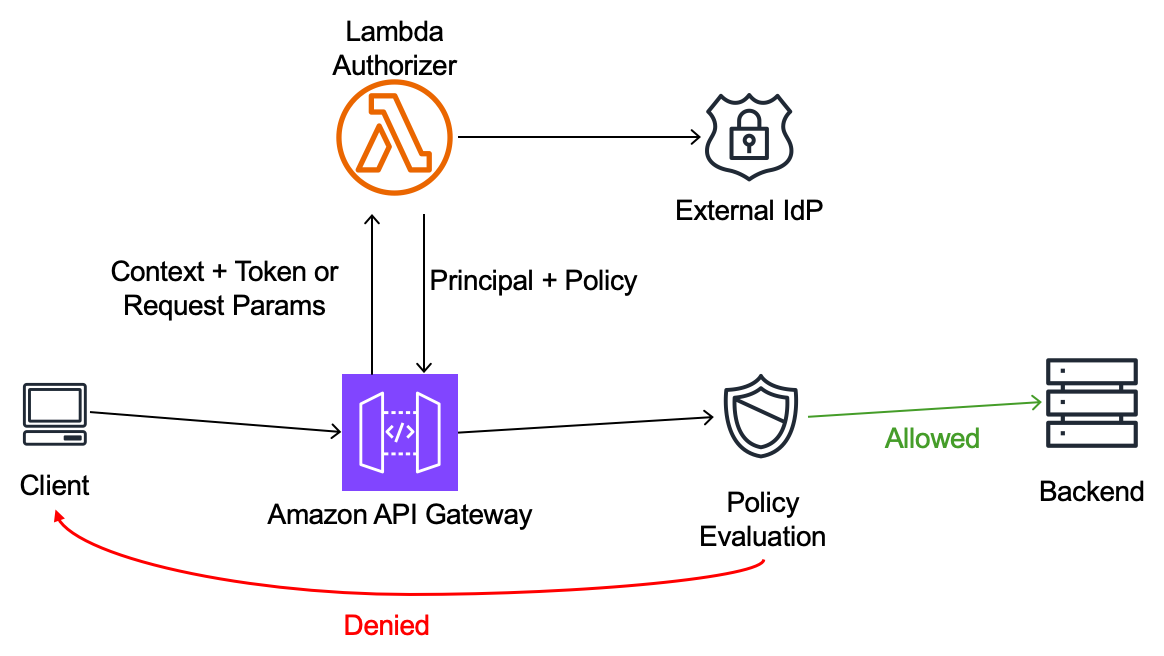
Security implementation throughout the API ecosystem adheres to zero-trust principles. Automated rate limiting and request throttling protect backend systems from denial-of-service vectors and unexpected traffic spikes. Comprehensive audit trails are automatically captured and shipped to Amazon CloudWatch, ensuring continuous visibility and adherence to global hospitality data privacy standards.
The quantitative and qualitative results of the deployment have proven transformative for Revinate’s enterprise operations. Customer onboarding timelines, previously stretching across weeks due to manual provisioning requirements, were compressed to mere days through the self-service capabilities of the developer portal. Operational overhead associated with infrastructure maintenance decreased substantially, allowing engineering teams to accelerate product release cycles.
Furthermore, the integration of structured usage plans and Terraform-managed governance established a single source of truth for API specifications, virtually eliminating documentation drift and integration errors among partner developers. By aligning cost structures directly with business expansion through consumption-based pricing, Revinate has solidified a scalable foundation capable of supporting its ongoing global enterprise growth.
Future Roadmap and Broader Industry Implications
Building upon the successful deployment of outbound API services, Revinate’s technical leadership is currently planning to expand the utilization of Amazon API Gateway to encompass inbound APIs. This future enhancement will streamline data ingestion workflows where external partners push data directly into Revinate’s ecosystem, ensuring uniform security, monitoring, and governance across all bidirectional traffic. Additional evaluations include the implementation of advanced API Gateway features such as automated payload transformations, response caching, and deeper threat intelligence integration.
Industry analysts note that Revinate’s architectural journey offers a blueprint for software-as-a-service providers and enterprise organizations navigating rapid scale. By prioritizing fully managed AWS services, embracing infrastructure-as-code automation, and centering API strategies around exceptional developer experiences, enterprises can successfully decouple operational complexity from business expansion, ensuring long-term competitiveness in an increasingly digital global marketplace.